
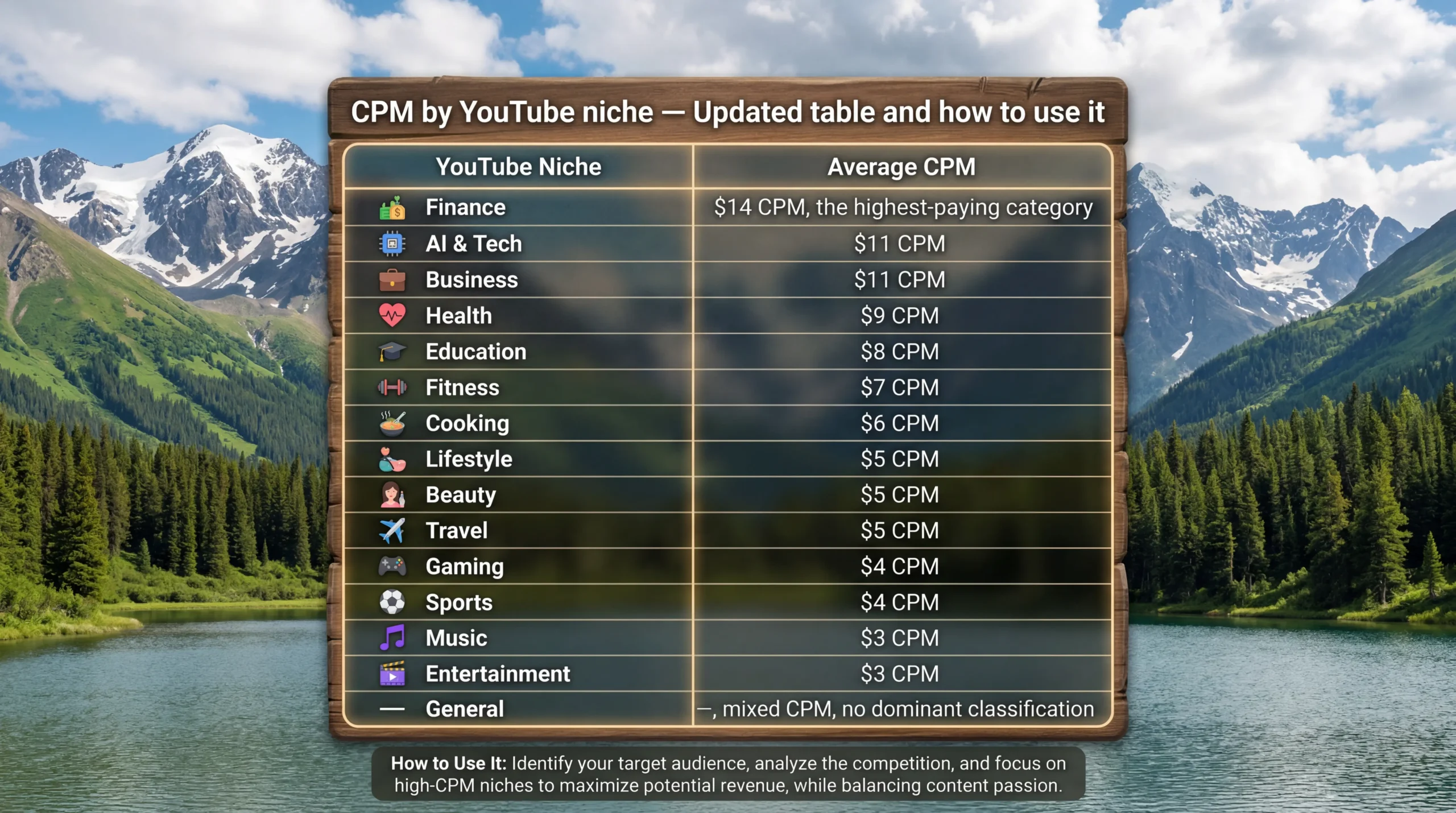
CPM (Cost Per Mille) is what advertisers pay per 1,000 ad impressions. On YouTube, CPM varies enormously by niche: a finance channel can generate 5–7x more revenue per view than a general entertainment one with the same subscriber count. This table compiles the reference values and explains what determines a niche’s CPM.
Key takeaways
- YouTube CPM ranges from $1–$3 (humor) to $12–$18 (finance) — 6x difference for the same view count.
- RPM (what you actually earn) ≈ CPM × 0.45–0.55 after YouTube’s cut and unmonetized views.
- Q4 CPMs run roughly 2x Q1 thanks to holiday advertiser spend.
- TubeKRadar (free) shows the estimated CPM on every video in the YouTube feed.
What CPM is on YouTube and how it affects your revenue
CPM = what the advertiser pays per 1,000 impressions.
RPM = what the creator receives per 1,000 views (after YouTube’s ~45% cut).
If your niche CPM is $14, your RPM will be roughly $7–$8. With 100,000 views per month, that’s $700–$800/mo from AdSense alone. In a $3-CPM niche, the same 100,000 views generate $150–$180/mo. The niche you pick multiplies or divides your revenue by a factor of 4 to 7 with the same production effort. If you already have the math down and just want the calculation applied to a real channel, see how to see YouTube channel revenue.
YouTube niche CPM table
| Niche | Typical CPM (USD) | Advertiser type |
|---|---|---|
| Finance / Investing | $12–$18 | Financial advertisers (high CPM) |
| AI & Tech | $10–$14 | Tech and SaaS |
| Business / Entrepreneurship | $10–$14 | Business tools |
| Legal / Law | $10–$15 | Legal services (small niche) |
| Health / Medical | $8–$12 | Insurance and pharma |
| Digital Marketing | $8–$12 | Digital tools |
| Education / Training | $7–$10 | Online courses |
| Fitness / Sports | $6–$9 | Supplements and gear |
| Cooking / Food | $5–$8 | Food and utensils |
| Travel | $4–$7 | Tourism and airlines |
| Lifestyle / Vlogs | $3–$6 | Consumer goods |
| Gaming | $2–$5 | Young audience, high volume |
| General entertainment | $2–$4 | Mass-consumer advertisers |
| Music | $2–$4 | Rights and mass consumption |
| Humor / Memes | $1–$3 | Very low CPM |
Note: values are reference estimates. Real CPM varies by audience language (English has higher CPM than Spanish), time of year (Q4 is the highest-CPM quarter), and viewers’ demographic profile.
Why CPM varies so much by niche
Advertiser intent
Advertisers in finance, insurance, or SaaS pay more because a single acquired customer can be worth thousands of dollars in LTV. A pet food advertiser can’t pay the same because the per-customer margin is much smaller. CPM directly reflects the advertiser’s per-customer value.
Viewer profile
A personal-finance niche attracts mid-to-high income people with purchasing power. A youth gaming niche attracts mostly under-25s with lower disposable income. Advertisers pay for access to actual buyers, not generic audience.
Audience language
English-speaking markets have larger advertising budgets than most others. An English channel in the same niche can have a CPM 30–60% higher than its Spanish equivalent. That said, competition in English is also significantly higher; sometimes lower CPM with lower competition wins. Covered in YouTube niches with low competition.
CPM vs RPM: which one to use for revenue calc
CPM is the figure you see in external tools and niche estimates. RPM is what actually lands in your AdSense account. The approximate relationship:
RPM ≈ CPM × 0.45–0.55Two reasons. First, YouTube retains roughly 45% of ad revenue. Second, not every view is monetized — adblock, viewers in regions without local advertisers, ad-ineligible videos. To calculate estimated channel revenue, use RPM, not CPM:
Estimated monthly revenue ≈ (Monthly views × RPM) / 1000How to see estimated niche CPM without owning a channel
With TubeKRadar (free with AutoKuak Suite), as you browse YouTube every video in the feed shows the detected niche and its estimated CPM. You can see in real time which niches generate which revenue level without owning a channel. Useful for three things:
- Compare monetization potential of different niches before picking one.
- See what CPM your competitors are working with.
- Identify subniches with high CPM but lower saturation.
With TubeKRadar you can also open any channel page and see estimated monthly revenue calculated using the RPM of the detected niche. The full calculation breakdown is here.
Seasonal CPM: when it goes up and when it drops
- Q1 (Jan–Mar):CPM drops. Advertisers have spent their Q4 budget and new budgets aren’t fully allocated yet. CPM can fall 30–40% from November.
- Q2 (Apr–Jun):CPM gradually recovers. Returns to normal values.
- Q3 (Jul–Sep): stable or slightly low CPM. Summer holidays.
- Q4 (Oct–Dec): highest CPM of the year. Black Friday, Christmas. Advertisers crank up spend aggressively. CPM can be 2x Q1 values.
For AdSense-focused channels, publishing more content in Q3 to capture views in Q4 is a valid strategy that almost every experienced faceless YouTuber applies.
Want to see live data on your next YouTube session?TubeKRadar is 100% free, no login, install in 30s.
What CPM you need to live off YouTube
Sample calculation with AI & Tech niche (RPM ~$6):
- Goal: $2,000/mo from AdSense.
- Required views: (2,000 / 6) × 1,000 = 333,000 views/mo.
- If each video pulls 10,000 views in its first month: you need ~33 active videos generating traffic.
With an entertainment niche (RPM ~$2):
- Goal: $2,000/mo.
- Required views: (2,000 / 2) × 1,000 = 1,000,000 views/mo.
- If each video pulls 10,000 views: you need ~100 active videos.
The niche determines whether your goal is reachable with 30 videos or with 100. That difference is critical when planning cadence and resources. To scale production when you need many videos, read how to build and scale a faceless YouTube channel with AI.
Frequently asked questions
What’s the difference between CPM and RPM?
CPM is what advertisers pay per 1,000 ad impressions. RPM is what the creator receives per 1,000 video views after YouTube’s revenue share (~45%) and after accounting for unmonetized views. Approximate rule: RPM ≈ CPM × 0.45–0.55. Use RPM for actual revenue forecasts.
Is TubeKRadar really free with no cap?
Yes. The CPM badge on every feed video and the channel-page revenue panel run on Free with no 24-hour cap, no signup wall. Niche Scan adds 2 free scans per 24 h with a Google sign-in; Pro lifts that to 100 per 24 h plus Niche Scan.
Where do the CPM values in the table come from?
They’re reference values calibrated from market patterns aggregated across audience, language, seasonality, and category. They are not pulled from any single channel’s private dashboard. Use them for niche comparison, not as exact predictions for a specific channel.
Why does CPM vary so much between English and Spanish channels?
Advertiser budgets are highly skewed toward English-speaking markets, especially the US. An English channel in the same niche can run CPMs 30–60% higher than its Spanish counterpart. That said, competition in English is also higher; sometimes a lower-CPM market with much less competition wins on net.
Does CPM differ between regular videos and Shorts?
Yes. Shorts use a separate revenue-share pool with lower per-view payouts. RPM on Shorts typically sits below regular video RPM in the same niche. Volume needed to reach the same revenue is much higher.
See CPM on every YouTube video, free
AutoKuak Suite’s TubeKRadar shows the estimated niche CPM on every video in the YouTube feed. Right on the thumbnail, no tab switching, free. To identify which niches have the best CPM and traction this week, activate the Pro plan with Niche Scan from $10.00/mo.