
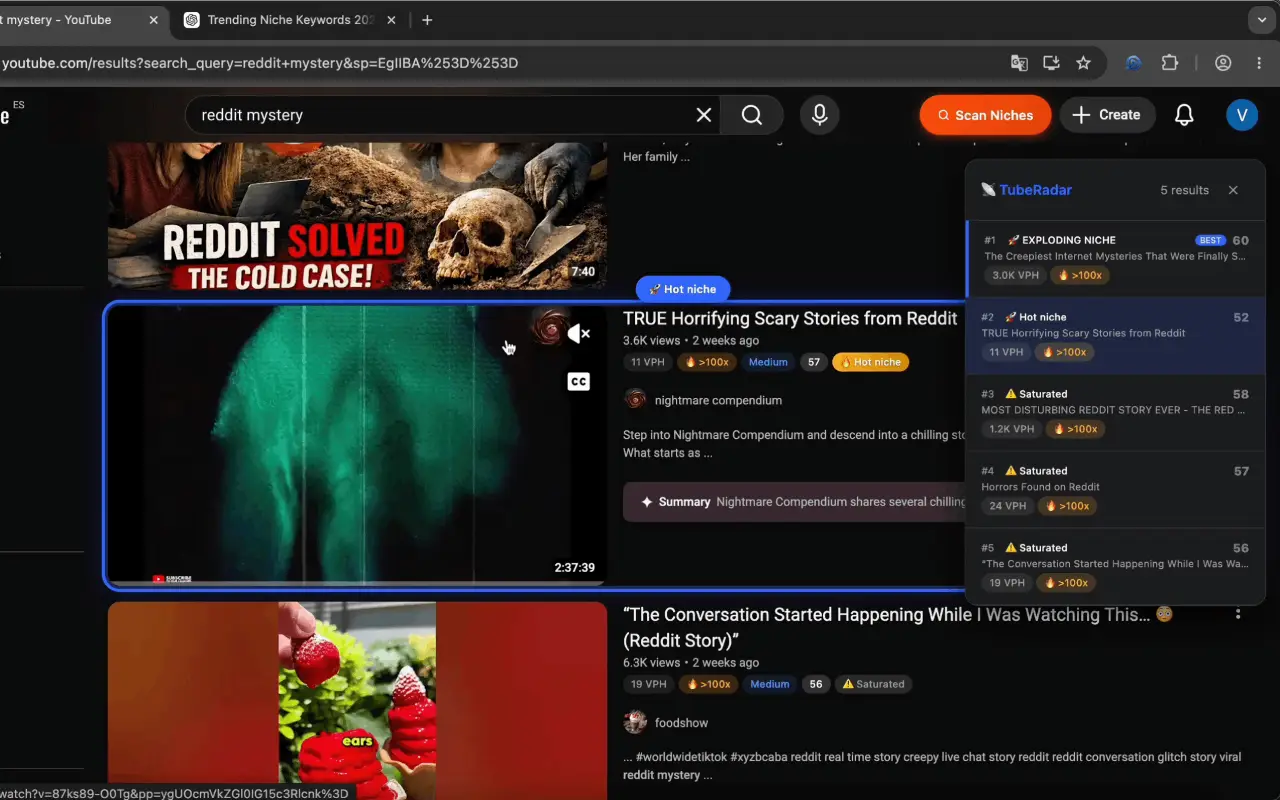
“No competition” on YouTube is rarely literally true. What does exist are niches with real demand but little quality supply, or emerging niches where most channels are still small. This guide explains how to identify them and which signals to watch.
Key takeaways
- Real low-competition niches show small channels with high views/day on recent videos.
- Four typical categories: subniches, emerging AI niches, geographic/language, and uncommon intersections.
- TubeKRadar (free) surfaces small-channel-with-high-views anomalies straight in the feed.
- Niche Scan auto-flags exploding niches; Niche Scan walks up to 50 feed passes per scan.
Why competition matters (and when it doesn’t)
YouTube is a recommendation system. In heavily saturated niches, new channels have to compete with established channels for the same keywords and the same audience. The algorithm tends to favor channels with longer history and more engagement signals. In low-competition niches, new channels can rank more easily because there’s not much reference supply. The key is finding the intersection point: enough demand for it to be worth publishing, but manageable competition so your channel can grow.
Signals that a niche has low competition
- Small channels with high views: if the most-watched videos in a niche come from a 50,000-subscriber channel, that’s a sign no big players are dominating.
- Recent videos with traction: if there are videos published less than 3 months ago with over 100,000 views and the channels that published them are small, there’s unmet demand.
- Few active channels: if searching the topic surfaces fewer than 10–15 channels publishing regularly, competition is manageable.
These signals are easier to evaluate with feed data than by opening every video manually. We use TubeKRadar or the Niche Scan button explained below.
Types of niches with typically lower competition
1. Subniches inside large categories
Instead of entering “fitness” (saturated), entering “calisthenics for people over 50” or “home gym routines without equipment” can find a spot with less direct competition. Practical rule: every time you add a qualifier to a broad niche, you reduce competition, and if the qualifier has demand, you’ve found your gap.
2. Emerging AI niches
New AI models (Grok, Sora, niche-specific models) have little tutorial content because they’re recent. Any channel that covers them early can rank well. The AI video generators comparison gives a sense of which tools are moving right now.
3. Geographic or language niches
If a niche has a lot of English content but little Spanish (or any other language), the underserved-language market can be accessible. AI, productivity, and business niches show this pattern right now: abundant English supply, scarce quality Spanish supply. Worth considering as a multi-language play if you can produce localized versions.
4. Uncommon intersections
Niches that combine two categories in unusual ways. For example: “productivity for graphic designers” or “personal finance for digital nomads”. The intersection narrows the audience but also narrows the competition, and if the specific audience has purchasing power, CPMs tend to be solid.
How to spot emerging niches before they saturate
Analyze fast-growing channels
Channels that are exploding in size are a signal that the niche has traction. If a channel with 20,000 subscribers is getting 500,000 views on recent videos, something is happening in that niche. With TubeKRadar (free with AutoKuak Suite) you can see directly in the feed the views/day of every video and the size of the channel that published it. That lets you spot these anomalies while you browse normally, without opening video by video.
Use Niche Scan for systematic analysis
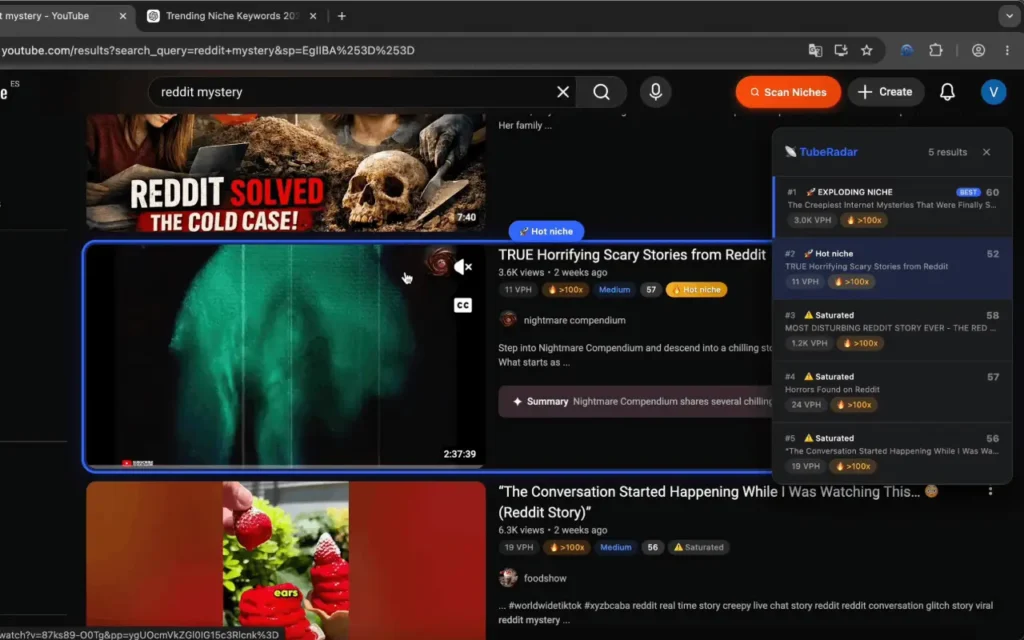
With Niche Scan the analysis is automated (Free 2 scans per 24 h with a Google account · Pro 100 per 24 h). The “Scan Niches” button on YouTube auto-scrolls the feed, detects videos with abnormal growth, and flags them with priority badges. The strongest signal is the “EXPLODING niche” badge: it activates when a small channel has 3+ recent videos with strong performance and a repeatable format. That signals the format is validated and the niche is active without being saturated yet.
Check Niche Scan weekly
Niche Scan (Pro plan) walks the feed whenever you ask it to and flags the niches with the most traction. It’s not strictly “niches without competition”, but it identifies where demand is growing in real time, which gives you the edge to enter before the rest of the market sees the signal.
Want to see live data on your next YouTube session?TubeKRadar is 100% free, no login, install in 30s.
A warning about “trending” niches
Niches exploding this week can saturate fast. If you enter a niche because it’s in this niche that just spiked, lots of other people are likely doing the same. The more robust strategy is to combine: use the scans to identify emerging trends, but pick niches that also have evergreen demand. Saturation is covered in another post: how to know if a YouTube niche is saturated.
Summary: what to do to find low-competition niches
- Turn TubeKRadar on and browse YouTube normally — the data shows up by itself.
- Watch for recent videos with high views/day from small channels.
- If you want active analysis, use Niche Scan (Free 2 per 24 h signed in · Pro 100 per 24 h) to auto-flag opportunities.
- Run a Niche Scan whenever you want a deeper pass over the feed.
- Validate the niche before committing: replicable format, evergreen demand, reasonable CPM.
The full niche-validation method is documented in how to find profitable YouTube niches.
Frequently asked questions
Are there really YouTube niches with zero competition in 2026?
Almost never literally zero. What exists are niches with limited quality supply, niches dominated by stalled channels that don’t update, and emerging crosses that no one is covering yet. The honest version is “low competition”, not “no competition” — and the 4 categories in this guide describe where to look.
Is TubeKRadar really free with no cap?
Yes. The base TubeKRadar features (in-feed views/day, channel size, detected niche, CPM) work indefinitely on Free with no 24-hour cap and no signup. Niche Scan adds 2 free scans per 24 h after a Google sign-in; Pro lifts that to 100 per 24 h plus Niche Scan.
How fast does a “low-competition niche” turn into a saturated one?
Depends on the trigger. Niches tied to a hot product launch (a new AI model, a viral format) can saturate in 4–8 weeks. Evergreen subniches with structural demand can stay low-competition for years. The Niche Scan badges ( Exploding vs Saturated) help you see where each niche sits on that curve.
Does TubeKRadar work on YouTube Shorts?
Yes. Metrics show on both regular videos and Shorts. Low-competition signals are often even stronger in Shorts because the format is newer and many evergreen niches haven’t been adapted yet.
What’s the difference between TubeKRadar and vidIQ/TubeBuddy for niche research?
vidIQ and TubeBuddy focus on optimizing your own channel (SEO, tags). TubeKRadar focuses on niche and competitor research — it surfaces views/day, channel size, and niche tags on every video without leaving the YouTube feed. Different goals, often used together.
Start free with TubeKRadar
To spot emerging niches on YouTube in real time, AutoKuak Suite’s TubeKRadar shows the signals directly in the feed. Fully free. To scan deeply for niches with traction, the Pro plans start at $10.00/mo.